At a Glance

To protect your house from care home fees in 2026, the "Gold Standard" strategy is a Property Protection Trust (PPT) combined with an LPA. This legal framework ring-fences 50% of your home's equity for your children while avoiding the high-risk "Deliberate Deprivation" traps associated with gifting your home during your lifetime.

How to protect your house from care home fees with a PPT Will
In 2026, a specialist PPT Will is the most robust way to protect your home from care fee assessments.
Last updated: April 2026 — England & Wales Law Author: Andrew Walters, Member of the Society of Will Writers

2026 Specialist Update Protecting your home from care fees is a priority for UK homeowners. A Property Protection Trust (PPT) remains the most resilient strategy to ring-fence equity while avoiding "Deliberate Deprivation" flags.

The 7 Essential Steps to Protecting Your House with a PPT Will

If you are a UK homeowner, the prospect of paying for care home fees can be daunting. With average costs soaring, many families are searching for ways to protect their legacy legally. Understanding the 2026 thresholds is the first step toward peace of mind.

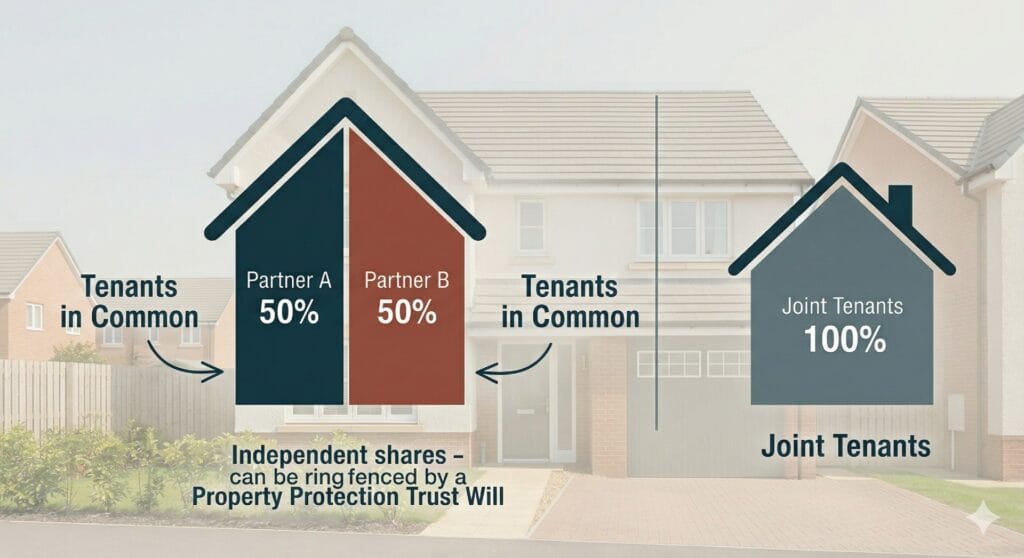
A clear diagram illustrating a house split into distinct shares, representing the Tenants in Common ownership model required for a Property Protection Trust Will to avoid care home fees.
A simplified look at how splitting property ownership (severing joint tenancy) allows you to ring-fence your share from care fee assessments.

How do I switch to Tenants in Common to avoid care home fees?

Direct Answer: To switch to Tenants in Common, you must "sever" your joint tenancy by filing a Form SEV with HM Land Registry. This ensures you each own a distinct 50% share of the property, which is the essential first step in ring-fencing your home from future local authority financial assessments.

By moving from Joint Tenants to Tenants in Common, you ensure that you own a specific, defined share of the home. This share is what allows for the creation of a protective trust, preventing the "Right of Survivorship" from automatically passing the whole house to a survivor—where it would be 100% vulnerable to care fee recovery. Severing your tenancy is the essential first step to protect your house from care home fees by creating two distinct 50% legal shares.

How does a Property Protection Trust (PPT) protect my home?

The Result: A PPT allows the first partner to die to leave their 50% share of the property in trust rather than to the survivor. Because the survivor does not "own" that capital—only a right to live there—that half of the home is generally ignored during the survivor's care home means-test.

A PPT is widely considered the "gold standard" for UK homeowners. It provides a legal shield against care costs because the trust assets are technically separate from the surviving partner’s personal wealth. It is specifically designed to protect your house from care home fees by ring-fencing 50% of the equity.

Deep Dive: Learn exactly how these trusts work in our Property Protection Trust Wills: The Ultimate 2026 Homeowner's Guide .

A close-up of a magnifying glass highlighting the phrase 'Deliberate Deprivation of Assets' on a UK legal document, warning against aggressive asset protection to avoid care home fees.
Local authorities carefully scrutinize asset transfers. Using a Property Protection Trust (PPT) Will ensures your planning remains legally compliant and transparent in 2026. Our mission at Xwills is to help you protect house from care home fees using legal, proven frameworks.

Will gifting my house to my children trigger a "Deliberate Deprivation" investigation?

The Risk: Yes. In 2026, UK local authorities scrutinize lifetime gifts heavily. If a council determines you "gifted" your home specifically to avoid care home fees, they can invoke Notional Capital rules—charging you for care as if you still owned the property.

Many homeowners mistakenly believe a simple transfer of title solves the problem. However, this almost always triggers a deliberate deprivation of assets investigation . The most transparent and legally robust way to protect your house is through a Property Protection Trust (PPT), which is a recognised form of succession planning rather than a suspicious lifetime gift.

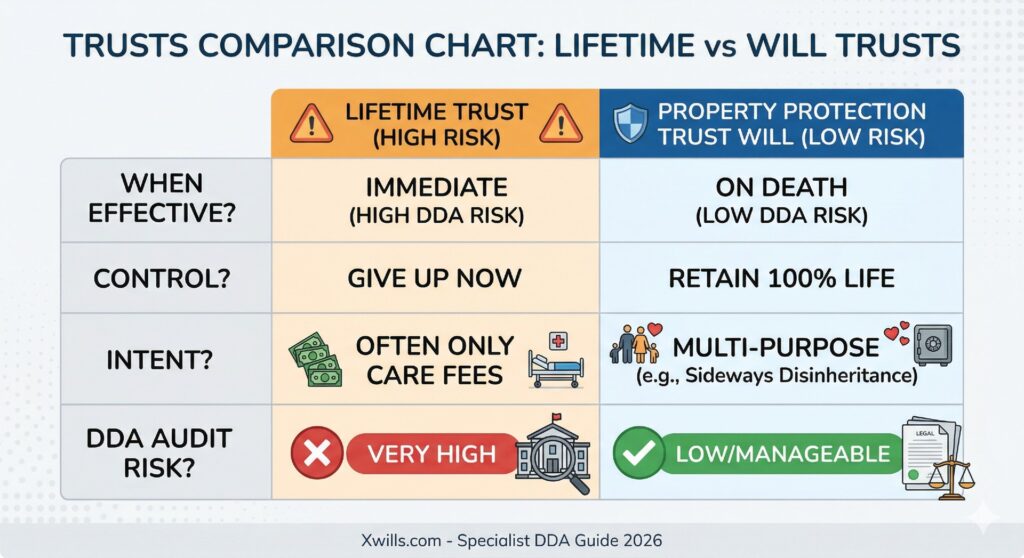
Why Xwills recommends Will-based trusts over immediate Lifetime Gifting for care fee protection.

Why are PPT Wills considered a safer alternative to lifetime gifting?

Direct Answer: Unlike lifetime gifts, a PPT Will only activates upon the death of the first spouse. Because the deceased is simply choosing how to bequeath their own 50% share of the property, it is far less likely to be viewed as deprivation of assets by the local authority compared to a healthy person giving away their home while still living in it.

This critical legal distinction is why specialist advice from Xwills is essential for 2026 compliance. A PPT Will provides the security of a "Life Interest" for the survivor while ensuring the capital is ring-fenced for the next generation in a way that respects current UK care legislation.

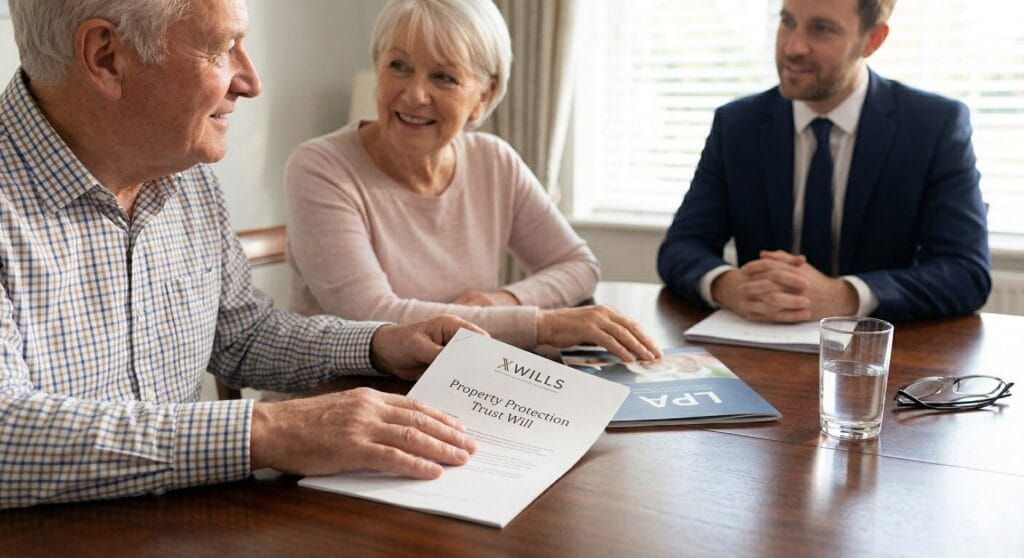
A relaxed elderly UK couple smiles in conversation with a consultant, holding their Property Protection Trust Will and LPA documents, signifying peace of mind against care home fees.
A comprehensive estate plan isn't just about assets; it’s about control. A Property Protection Trust Will secures your home, while a Lasting Power of Attorney (LPA) secures your future.

Can I still use other assets for paying care home fees?

The Strategy: Yes. By ring-fencing the property share through a PPT, you ensure the family home is preserved for your beneficiaries. This allows you to focus on paying care home fees using more liquid assets—such as savings, investments, or pensions—without risking the roof over your family's head.

This balanced approach satisfies the local authority's requirement for care funding while legally securing 50% of the home's value. It provides a clear "paper trail" that distinguishes between spending your accessible wealth and protecting your legacy.

Why is a Lasting Power of Attorney (LPA) essential for asset protection?

The Core Duo: Asset protection is only half the battle. While a Property Protection Trust Will secures the house after death, an LPA is the only legal tool that ensures a trusted person can manage the process of paying care home fees and managing your home if you lose mental capacity while alive.

Without an LPA in 2026, your family could be legally "locked out" of your bank accounts and unable to deal with the Land Registry or local authority on your behalf. We recommend the "Core Duo" of a PPT Will and LPA for total estate security. Pairing a Trust with an LPA is the only way to fully protect your house from care home fees if you ever lose mental capacity.

When is the best time to protect my house from care home fees?

The Golden Rule: Early Intervention.

The most effective way to protect your house from care home fees is to act while you are healthy and independent. If you wait until a care need is imminent or a diagnosis is received, your planning is significantly more likely to be challenged during a local authority audit under "Deprivation of Assets" rules.

Professional planning in 2026 requires foresight. Don't leave your children's inheritance to chance. Ultimately, the best time to protect your house from care home fees is while you are healthy and independent.


Is Your Family Home Protected?

Don't leave your legacy to chance. Speak with an Xwills specialist today to secure your property and your peace of mind. Our specialist team can help you protect your house from care home fees using legal, proven frameworks for 2026.

Book Your Free 2026 Property Consultation