At a Glance

Digital assets estate planning in the UK is no longer a grey area. Following the Property (Digital Assets etc.) Act 2025, your crypto, NFTs, and digital data are officially recognised as personal property. In 2026, failing to include these in your Will means vital financial assets and family memories risk being "digitally buried" forever behind encryption that no court order can break.

Digital assets estate planning UK: A physical key and a phone displaying the XWILLS.COM Digital Assets Memorandum.
Secure your physical and digital legacies with XWILLS.COM’s 2026 standards.
Last updated: April 2026 — England & Wales Law Author: Andrew Walters, Member of the Society of Will Writers

Digital Assets Estate Planning UK: The 2026 Definitive Guide

Everything you need to know about protecting your crypto, cloud photos, and digital legacy under the Property (Digital Assets etc.) Act 2025.


Direct Answer: Digital assets estate planning in the UK is the process of legally and technically organising your online life—from Bitcoin to family photo clouds—to ensure they pass to your heirs. Under the Property (Digital Assets etc.) Act 2025, these items are now legally recognised as property, making their inclusion in your Will essential to prevent permanent loss and frozen accounts.

How does the Property (Digital Assets etc.) Act 2025 affect my Will?

For decades, English law struggled to categorise "bits and bytes." On 2 December 2025, the UK Parliament enacted a landmark law that officially recognised digital assets as a distinct third category of personal property.

The Three Pillars of UK Property Law:

  • Things in Possession: Items you can physically hold, such as cars, artwork, or your home (which can be secured via a Property Protection Trust).
  • Things in Action: Enforceable legal rights (Debts, Shares).
  • Digital Assets: The new category for crypto, NFTs, and specific digital records.

The Reality: While the law now protects your ownership, it doesn't give your family a magic password. Digital assets estate planning UK is required to bridge the gap between legal rights and technical access.

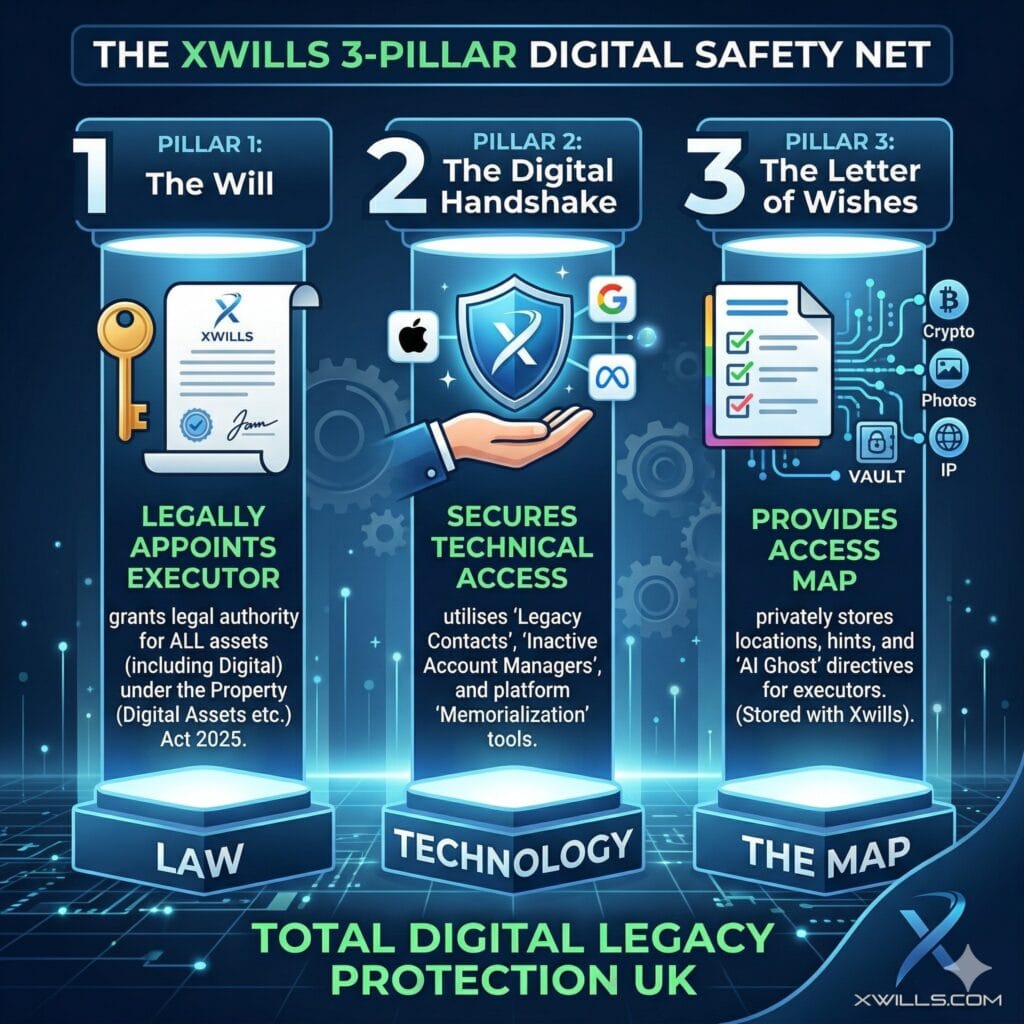
An infographic illustrating the Xwills 3-pillar method for digital assets estate planning UK, showing Law, Technology, and The Map.
Secure your physical and digital legacies with Xwills’ unique 3-Pillar Framework.

Which digital assets need to be included in a UK Will?

Not all data is created equal. Under digital assets estate planning UK standards, we categorise your online footprint into three distinct "value types." Each requires a different approach to ensure your executors can fulfil their duties.

Asset CategoryExamplesThe Risk
Financial AssetsBitcoin, Ethereum, PayPal balances, Premium Bonds (Digital), NFTs.Permanent loss of capital if private keys or 2FA are inaccessible.
Sentimental AssetsiCloud/Google Photos, Social Media accounts, Personal Email.Automatic deletion by platform scripts after 6-12 months of inactivity.
Intellectual PropertyDomain names, YouTube royalties, Substack subscriptions, Kindle KDP.Business interruption and loss of recurring income for beneficiaries.

Important for 2026: The Property (Digital Assets etc.) Act 2025 makes it clear that "Financial" digital assets are now legally distinct from "Sentimental" ones. While you might want your spouse to have your photos, you might need a specialist Digital Executor to handle your crypto-wallets.

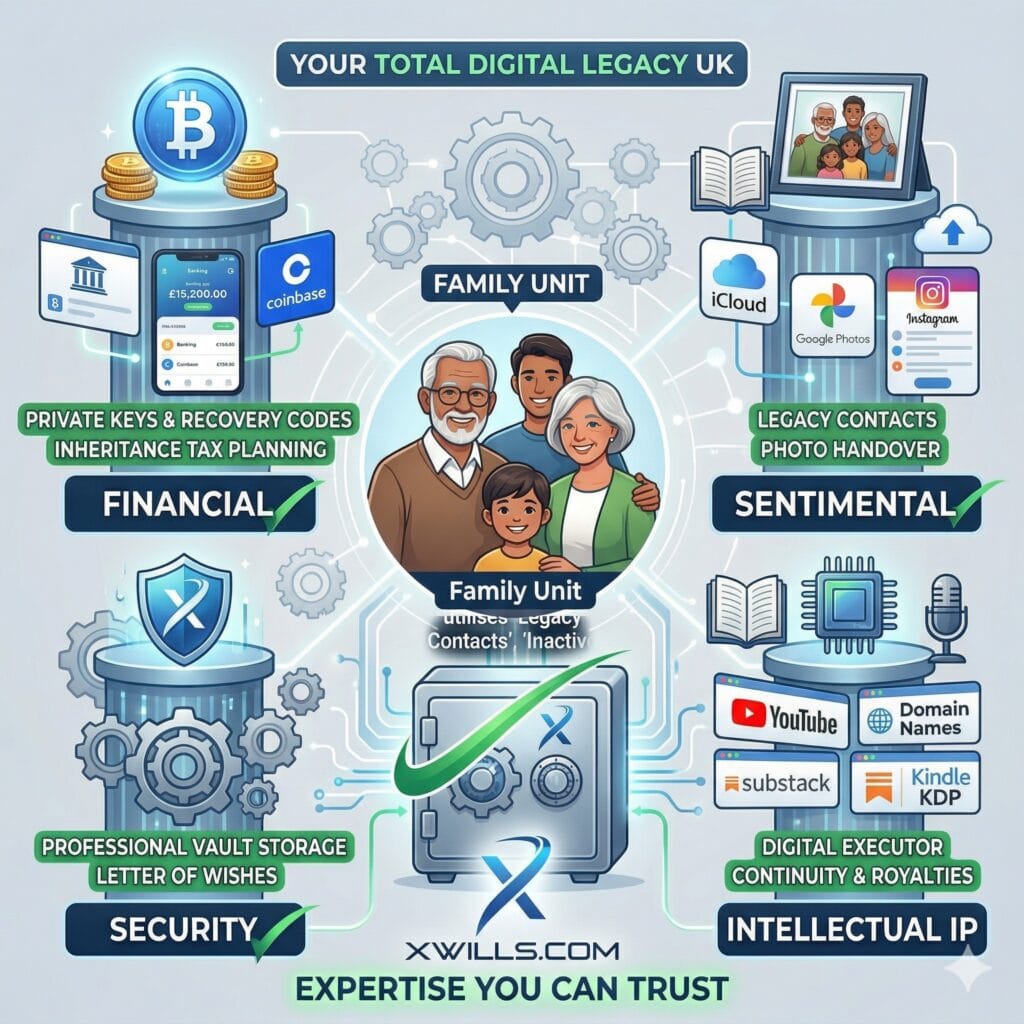
An infographic diagram illustrating the holistic Xwills digital assets estate planning UK ecosystem, showing Financial, Sentimental, and Intellectual pillars secured by Xwills.
Map your total legacy: The Xwills digital asset ecosystem guides your family.

Should I appoint a separate 'Digital Executor' in my UK Will?

In 2026, the role of an executor has evolved. While your primary executor handles the physical house and bank accounts, they may not have the technical literacy to manage a hardware wallet or a monetised YouTube channel.

Why a Specialist Digital Executor is Essential:

  • Technical Competence: They understand how to use password managers, VPNs, and 2FA recovery codes.
  • Asset Protection: They can quickly secure social media accounts before they are hacked or memorialised.
  • IP Management: They ensure digital royalties and domain renewals don't lapse during the probate period.

Xwills Advice: You don't necessarily need a different person, but you do need specific wording in your Will that grants your executor the power to manage digital interests. Under digital assets estate planning UK best practices, we recommend a "Co-Executor" model for high-value digital estates.

Pro Tip: Choosing the right person is critical for 2026 compliance. You can find more answers on how to select and empower your representatives in our Comprehensive FAQ Guide.

Did you know? Without explicit "Digital Power" clauses, some UK banks and tech platforms may refuse to recognise an executor's authority over encrypted data, even with a Grant of Probate.

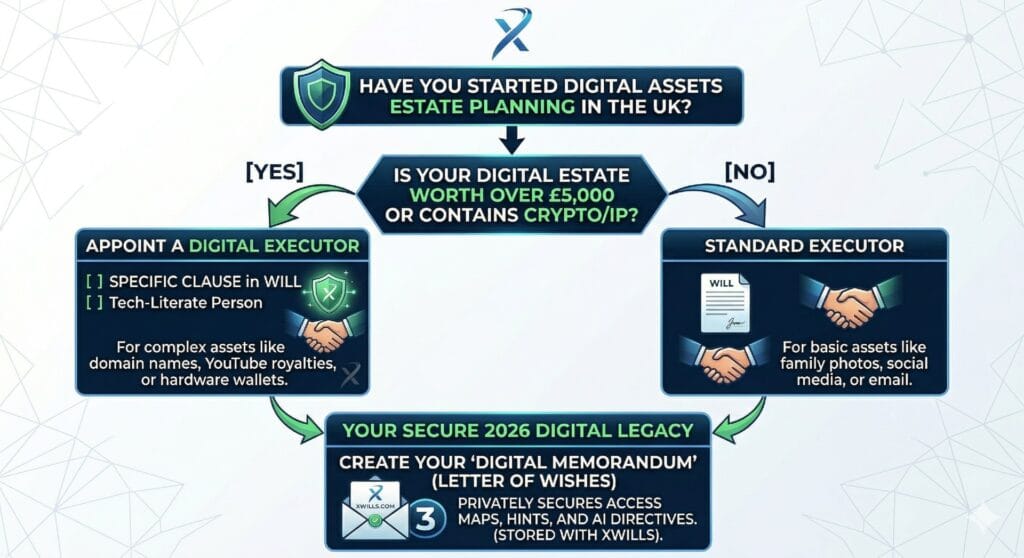
An infographic diagram for digital assets estate planning UK, showing a decision tree for when to appoint a specific digital executor. It details that a 'specific clause' is needed in the Will for crypto/IP worth over £5,000.
Map your logic: A quick decision tree to guide your digital asset executor choice.

Where is the safest place to store digital recovery keys and passwords?

This is the ultimate paradox of digital assets estate planning in the UK: you need your keys to be impossible to hack today, but easy for your executor to find tomorrow. Storing a password in a Will is a critical security risk, as Wills become public documents after probate.

The "Digital" Solution

Use a Password Manager (Bitwarden or 1Password) with "Emergency Access" enabled. Your executor can request entry, and if you don't deny it within 7 days, they are in.

The "Physical" Solution

A sealed Digital Asset Memorandum stored in our professional vaults alongside your Will. It contains locations and hints, not raw passwords.

Expert Warning: Never store your 12-word Crypto Seed Phrase or your Apple Recovery Key in an unencrypted email or cloud note. In 2026, cyber-criminals actively scan for these during "digital probate" windows.

The Xwills "Triple-Lock" Method:

  1. The Will: Grants legal authority to the Digital Executor.
  2. The Password Manager: Handles the day-to-day logins and MFA.
  3. The Physical Vault: Holds the hardware keys and "emergency-only" recovery codes.

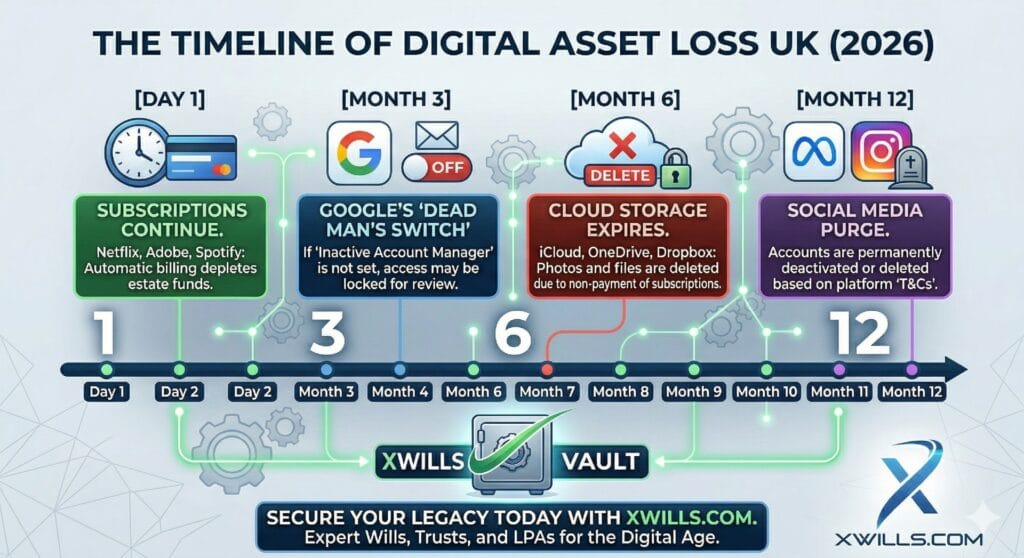
How do I stop 'Vampire Subscriptions' from draining my estate?

In 2026, the average UK household has 10+ active digital subscriptions. Without digital assets estate planning UK, these "vampires" continue to withdraw funds from your bank accounts for months while probate is processed, often depleting the cash meant for your beneficiaries.

Note: Preventing these charges while you are still alive but unable to manage your affairs requires a valid Lasting Power of Attorney (LPA). Without an LPA, your family may be legally powerless to stop automated digital payments.

The Cost of Inaction:

If an estate takes 9 months to settle, uncancelled subscriptions to Adobe, Netflix, Amazon Prime, and Gym memberships can cost over £1,200 in wasted funds.

Under the Property (Digital Assets etc.) Act 2025, your executors have the legal standing to cancel these contracts, but they rarely have the login details to do so quickly.

The Xwills 'Kill-Switch' Strategy:

  • Inventory: Use your banking app to export a list of all 'Continuous Payment Authorities'.
  • Instructions: Explicitly list which services (like iCloud) should stay active to preserve data, and which should be killed immediately.
  • Access: Provide the 'Master Password' to your vault so your executor can log in and click 'Cancel' in seconds.

An infographic timeline illustrating the rapid decay of a digital estate over one year after a person's death in the UK, showing subscription billing, Google locks, cloud data deletion, and social media purges.

AI Ghosts: Do I need a 'Likeness Clause' in 2026?

We have officially entered the era of "Grief Bots." Using your voice notes, videos, and social media history, AI can now create a digital recreation of your personality. While some find comfort in this, others consider it a violation of their dignity.

The 2026 Legal Reality: Your "voice and image rights" are now part of your digital assets estate planning UK strategy. If you do not specify your wishes, tech companies may use your data to train models or create "legacy avatars" without your family's consent.

What to include in your Xwills 'AI Clause':

1. Consent: Explicitly state if you forbid the use of your data for AI reanimation.

2. Royalties: If your AI likeness is used (e.g., for a professional voiceover), specify who inherits the earnings.

3. Deletion: Direct your executor to request the deletion of biometric data from private servers.

Don't Leave Your Digital Life to Chance

Traditional Wills aren't enough in 2026. Protect your crypto, your memories, and your dignity with a modern Xwills Estate Plan.

Book Your Free Digital Assets Consultation

Xwills: Expert Wills, Trusts, and LPAs for the Digital Age.