
At a Glance

Regarding the question, "Are Next of Kin Responsible for Care Home Fees?"—the answer in 2026 is No. Under the Care Act 2014, next of kin are not legally liable for a relative's care costs in the UK. However, while your personal savings are safe, the family home remains 100% vulnerable to being sold unless proactive legal steps are taken to ring-fence the property equity.

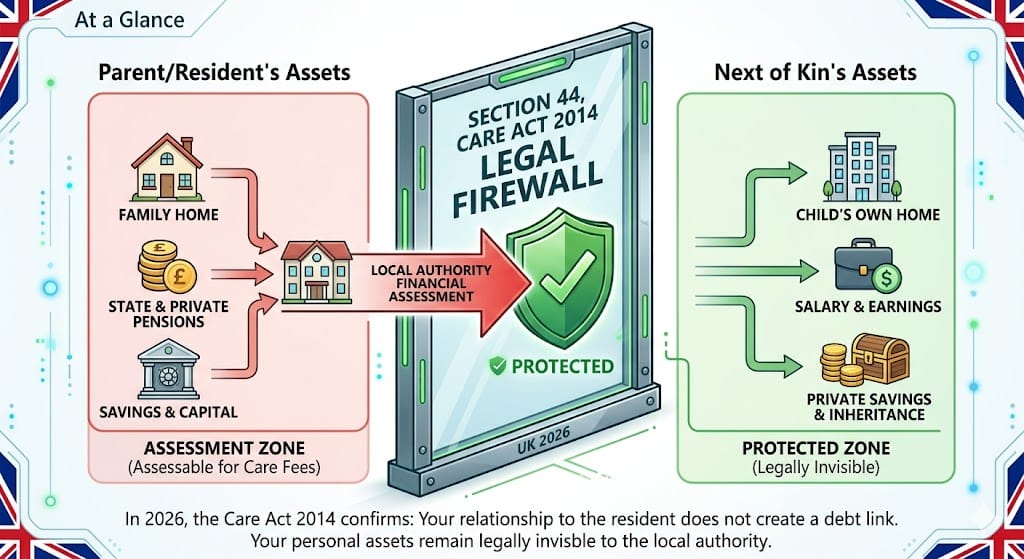
Diagram of UK Care Act 2014 Section 44 legal firewall protecting next of kin assets from care home fee assessments in 2026.
The 2026 Legal Firewall: Under the Care Act 2014, your personal assets (salary, home, and savings) are legally invisible to local authority care fee assessors.
Last updated: May 2026 — England & Wales Law Author: Andrew Walters, Member of the Society of Will Writers
Are Next of Kin Responsible for Care Home Fees? A compassionate nurse caring for an elderly man, both smiling, in a high-quality UK care setting.
UK Care in 2026: While professional care is compassionate, understanding the distinct legal boundaries of 'next-of-kin liability' is essential for every homeowner.
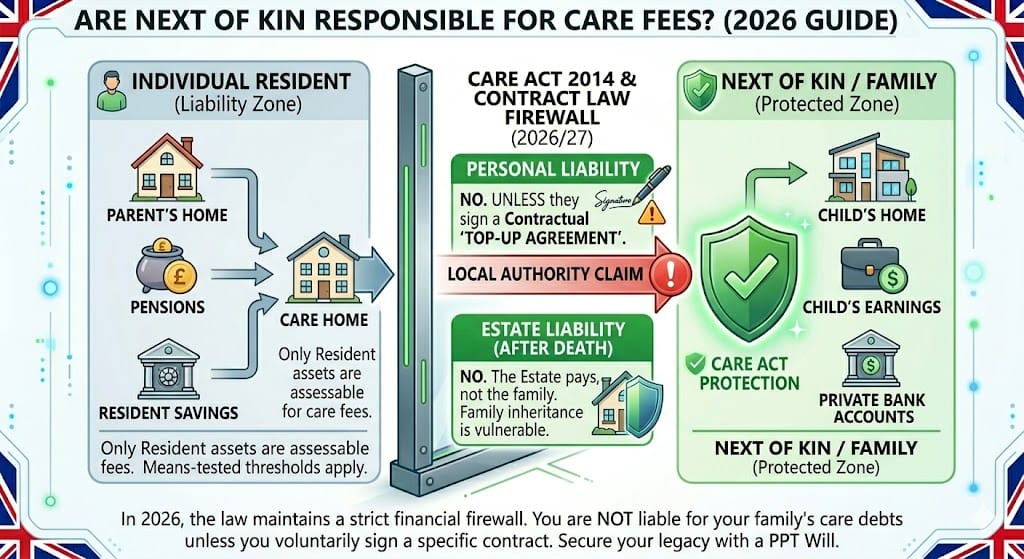
Infographic diagram illustrating the 2026 UK legal firewall that separates a resident's care liability from their next of kin's personal assets (salary, home, savings), confirming that families are NOT responsible by law.
Visualizing the 2026 Legal Reality: UK law maintains a strict financial firewall. You are NOT liable for your family’s care debts unless you voluntarily sign a specific contract.

Are Next of Kin Responsible for Care Home Fees?

One of the most common concerns for UK families in 2026 is: Are Next of Kin Responsible for Care Home Fees? The short answer for any child, spouse, or relative is No. Under the Care Act 2014, next of kin have zero legal liability for a family member’s care costs; UK law treats every adult as a separate financial entity.

When a local authority conducts a financial assessment, they are legally restricted to looking only at the assets and income of the person receiving care. Your savings, your property, and your salary are entirely exempt from their calculations.

The 2026 Legal Reality:

Even if you are the primary "Next of Kin" or hold Lasting Power of Attorney, you are an administrator, not a guarantor. You are responsible for managing their funds, but the council cannot force you to spend your own money when addressing care home fees responsibility.

Legal Verification & Sources:

What the Council Cannot Assess:

  • Child's Earnings: Your salary and workplace benefits are 100% exempt.
  • Next of Kin's Property: Your own home is never part of their means test.
  • Private Savings: Your personal bank accounts remain legally invisible.
What is the "Third-Party Top-Up" Trap?

The Only Exception: While you are not liable for care fees by law, you can become liable by contract. When asking "Are Next of Kin Responsible for Care Home Fees?", the answer changes to "Yes" the moment you sign a voluntary Top-Up agreement.

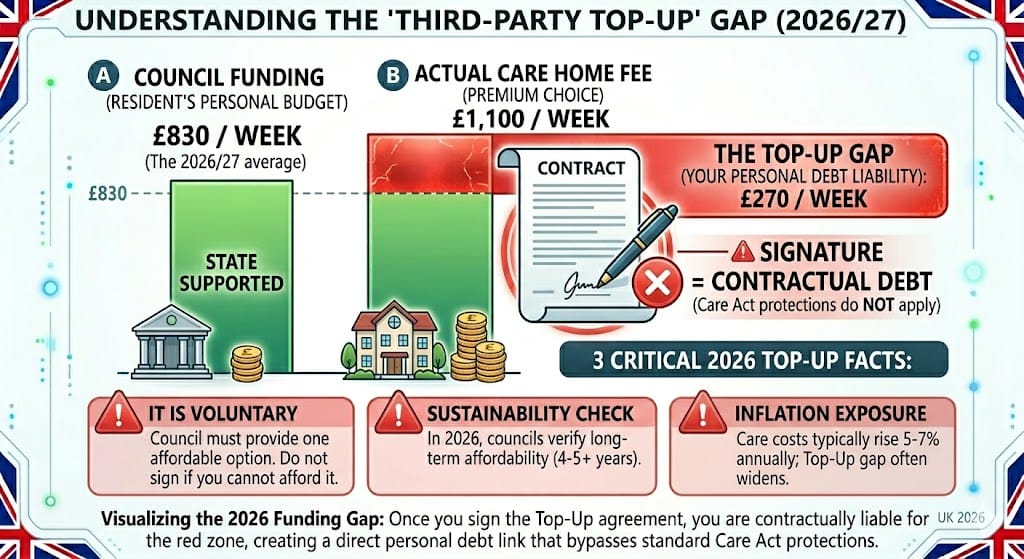
If the local authority assesses a resident's "Personal Budget" at £830 per week, but you prefer a care home that costs £1,100, the council will ask you to sign an agreement to pay the £270 difference. Once signed, this is a legally binding private contract where you accept personal liability.

The 2026 Risk Warning:

Unlike standard care fees, a Top-Up is a personal debt. If the care home raises its fees in 2026 and the council budget stays stagnant, your personal liability increases. This is the primary trap regarding care home fees responsibility for next of kin.

3 Critical Facts Before You Sign:

  • It is Voluntary: The council must provide at least one affordable care home option. You only pay a Top-Up if you reject that option.
  • Sustainability Check: In 2026, councils must verify you can afford these payments long-term.
  • Inflation Exposure: You are responsible for the gap. As care costs rise, the gap usually widens.
2026 Infographic showing the financial gap between UK local authority care funding and premium care home fees, with symmetrical risk boxes and no branding.
The 2026 Funding Gap: A visual guide to contractual liability for next of kin, showing the risk of voluntary top-up payments.

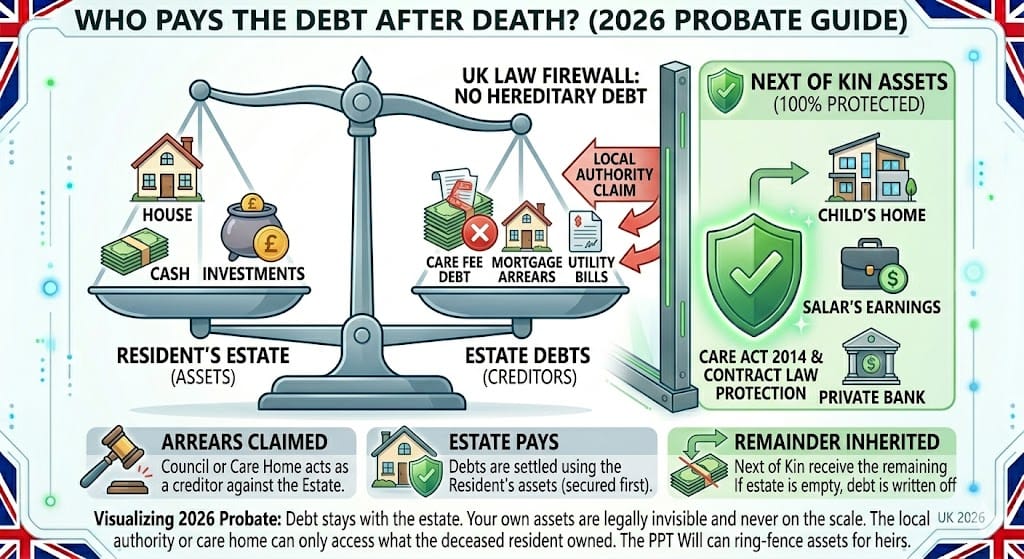
Who pays the debt after death?

One of the most persistent fears for next of kin is the idea of "inheriting" a care fee debt. In the UK, debt is not hereditary. If a resident passes away with outstanding care home fees, the debt belongs to the estate, not to the children.

In 2026, the local authority or the care home acts as a creditor. They will seek payment from the deceased’s assets (money, property, or investments). If the estate has no assets left, the debt usually remains unpaid and is eventually written off. The council cannot legally demand that a child pay a parent’s debt from their own pocket.

The Probate Connection:

As the executor, you must ensure all debts are settled before distributing inheritance. If you distribute the estate to yourself or siblings while knowing a care debt exists, you could become personally liable for that oversight. This is why tracking a probate application correctly is vital.

The Hierarchy of Payment (2026 Rules)

  • 1. Secured Debts: Any "Deferred Payment Agreements" (where the council put a charge on the house) are paid first upon sale.
  • 2. Unsecured Care Arrears: These are settled from the remaining cash in the estate.
  • 3. The Heirs: Next of kin receive whatever is left after all creditors are satisfied.

The Solution: If the parent’s 50% share was placed in a Property Protection Trust, that money is "locked" for the children and is generally not available to care home creditors after death.

Infographic illustrating UK probate rules for care fee debts in 2026, showing that debt stays with the deceased’s estate while next of kin assets remain protected behind a legal firewall.
Visualizing 2026 Probate: Debt stays with the estate. Your own assets are legally invisible and never on the scale; the local authority can only claim against what the deceased owned.

How Do I Protect the Family Home?

In 2026, protecting your home is about using established trust law to ensure your inheritance is safe. While we have established that next of kin are not responsible for care home fees personally, your family home is at risk. The most effective method to save it is a Property Protection Trust (PPT) Will.

Most couples own their home as "Joint Tenants," meaning when one dies, the other automatically owns 100%. If that survivor later needs care, the council can assess the entire house. By changing ownership to Tenants in Common, you can each gift your 50% share into a Trust via your Will, effectively answering the question: "Are next of kin responsible for care home fees through their inheritance?" with a definitive protective strategy.

The 2026 Strategy:

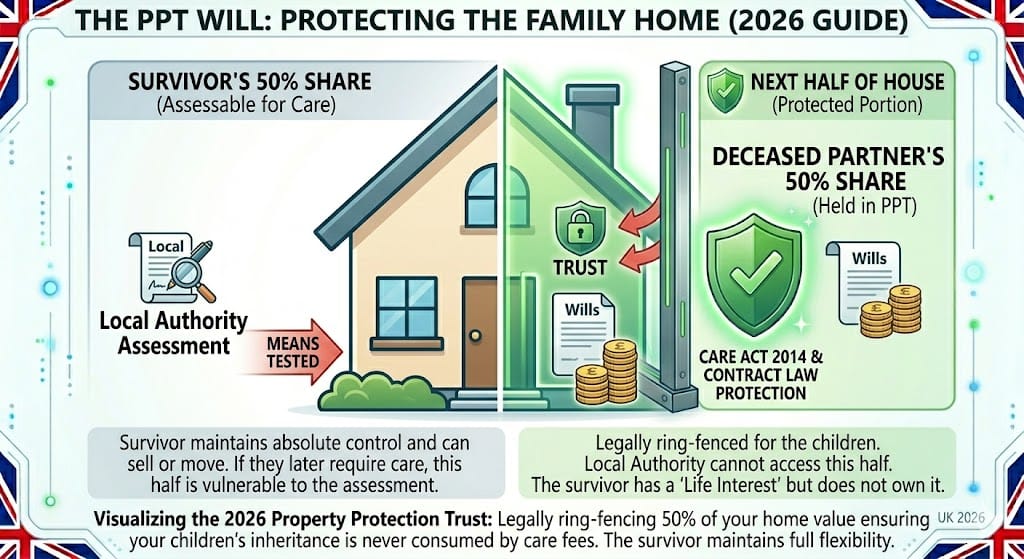
When the first partner dies, their 50% share goes into the Trust. The survivor has a Life Interest—the legal right to live in the house for life—but they do not own that half. If the survivor needs care, the council can only assess the 50% they personally own. The Trust's half is legally invisible and protected for your children.

3 Key Benefits of a PPT Will:

  • Ring-Fencing: Guarantees at least 50% of the property value passes to your children.
  • Security: Protects your children's inheritance even if the surviving spouse remarries.
  • Flexibility: The survivor can still sell the house to downsize; the Trust simply moves to the new property.
Infographic showing a house split 50/50 to illustrate how a Property Protection Trust (PPT) Will works in 2026, with one half protected by a trust shield for heirs.
Visualizing the 2026 Property Protection Trust: Legally ring-fencing 50% of your home value to ensure your children’s inheritance is never consumed by care fees.

What is the 2026 Protection Bundle?

The law provides a "firewall" for your personal assets, but it does nothing to protect your inheritance. To ensure your family home isn't treated as a cash machine, our 2026 Protection Bundle is designed to definitively solve the risk of care home fees responsibility.

1. PPT Mirror Wills

Specialised Wills that trigger a 50% property ring-fence upon the first death, protecting your equity from future care assessments.

2. Severance of Tenancy

Legal transition from Joint Tenants to Tenants in Common, ensuring each partner has a distinct share to place into trust.

3. Health & Welfare LPA

Empowers your family to make medical and care decisions, preventing the local authority from making unilateral choices.

4. Finance & Property LPA

Ensures your family can manage bank accounts and property without costly and slow Court of Protection intervention.

Secure Your 2026 Assessment Review

*Book today to receive a comprehensive review of your current deeds and a personal liability audit.*