

At a Glance

A Property Protection Trust (PPT) Will is a specialist legal arrangement used by couples to protect 50% of their home's value. In 2026, it remains the primary way to secure a legacy for children while ensuring a surviving partner has a guaranteed, lifelong right to reside in the home.

Property Protection Trust Wills: Fixed Fee Home Protection for UK homeowners 2026

Last updated: March 2026 — England & Wales Law | Author: Andrew Walters, Member of the Society of Will Writers

Property Protection Trust Wills: The Ultimate 2026 Homeowner's Guide

Everything you need to know about ring-fencing your home, protecting your children's inheritance, and navigating 2026 care cost laws.


What is a Property Protection Trust (PPT) Will?

Direct Answer: A Property Protection Trust (PPT) Will is a specialised legal document that "splits" property ownership upon the first partner's death. It grants the survivor a "Life Interest" to stay in the home, while legally securing the deceased partner's 50% share for their children—protecting it from being consumed by care home fees or lost through remarriage.

In 2026, a PPT Will is considered the "gold standard" for homeowners. Unlike a standard Will, which leaves your assets "open" to future risks, a PPT Will is a specialised Trust designed to ring-fence your share of the family home.
How do I prevent "Sideways Disinheritance" with a PPT Will?

One of the most frequent queries we receive at Xwills involves "sideways disinheritance." If you die and leave your home solely to your spouse, and they later remarry, their original Will is automatically revoked under Section 18 of the Wills Act 1837.

If the survivor fails to make a new Will, or if they prioritise their new family, your children could be entirely disinherited from your share of the home. A PPT Will ensures your 50% share is legally "locked" for your children, regardless of what happens to your surviving spouse later in life.

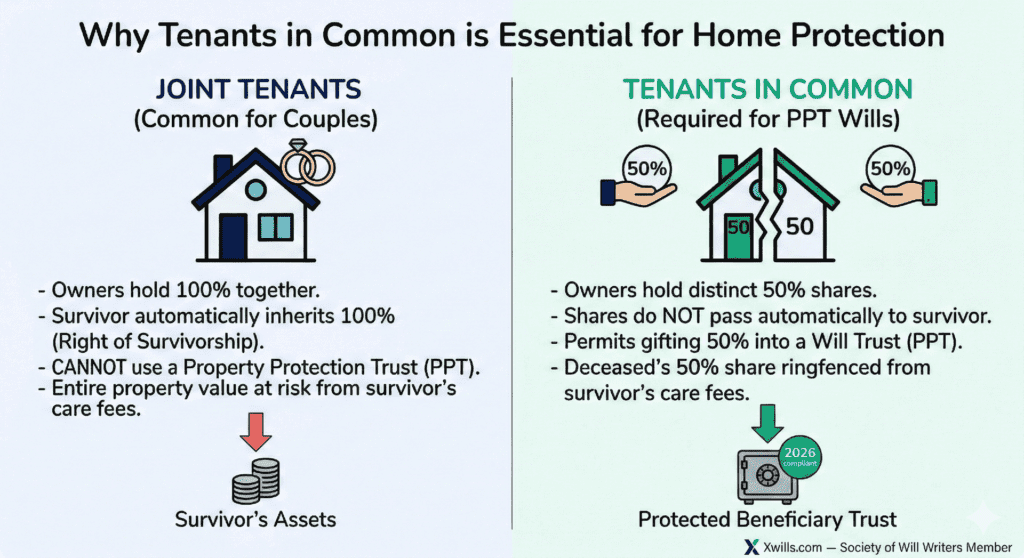
Diagram showing the difference between joint tenants and tenants in common for a PPT Will in England and Wales 2026
Fig 1: Severing joint tenancy to become Tenants in Common is a required legal step to protect property with a Will Trust.

Do I need to be "Tenants in Common" for a Property Protection Trust?

Direct Answer: Yes. To activate a Property Protection Trust Will, your property must be owned as Tenants in Common. This ensures you each own a distinct 50% share that can be placed into Trust, rather than passing automatically to a survivor via the "Right of Survivorship."

Most UK couples own their home as "Joint Tenants." Under this setup, the property is viewed as one single entity. When one owner passes away, the house automatically becomes the 100% property of the survivor, regardless of what is written in a Will. This is known as the Right of Survivorship, and it is the primary reason why standard Wills fail to protect assets from care home fee recovery.

The Process of Severing Joint Tenancy

To protect your assets, we must "sever" the joint tenancy. This does not change who lives in the house or your mortgage obligations; it simply changes the legal "nature" of your ownership from one single block into two defined 50% shares.

  • Fixed Shares: Each partner owns a specific 50% share. You gain the "Testamentary Freedom" to leave that share to a Trust rather than it being absorbed by the survivor.
  • Survivor Protection: The survivor retains a "Life Interest," meaning they have an absolute right to remain in the property for their lifetime.

Xwills handles the Land Registry Form SEV filing as part of our service. This ensures your title deeds at HM Land Registry are correctly restricted with a "Form A Restriction."

Warning: If you draft a PPT Will but fail to sever the tenancy, the Trust will be "empty" and the protection will be 0%.

How do I set up a Property Protection Trust Will in 2026?

Securing your home shouldn't be a bureaucratic nightmare. At Xwills, we have refined a four-stage process to ensure your Property Protection Trust and LPAs are legally watertight and fully compliant with 2026 standards.

Step 1: The Discovery Call

We begin with a free initial consultation to assess your property value and specific family needs, identifying potential "Sideways Disinheritance" risks.

Step 2: Severing the Tenancy

We prepare and file Form SEV with HM Land Registry. This converts your home to Tenants in Common, a vital step for the Trust to function.

Step 3: Specialist Drafting

Andrew Walters (SWW) drafts your PPT Wills and LPAs. We include "Life Interest" clauses and modern Digital Asset provisions tailored to 2026 law.

Step 4: Physical Execution

We oversee the "wet-ink" signing of your deeds. You are then provided with a completed submission pack, ready for you to send to the OPG for final registration.

Note: The full drafting process typically takes 4–6 weeks from initial consultation to the delivery of your signature-ready documents.

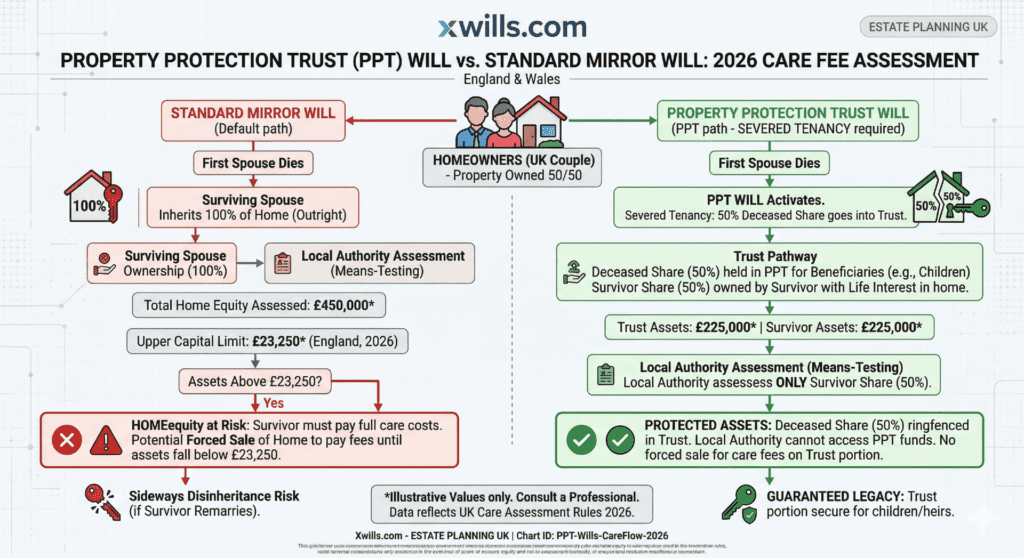
Flowchart comparing property protection trust wills vs standard wills for care fee assessment 2026
Fig 2: Comparison of asset protection levels between a standard Mirror Will and a Property Protection Trust Will.

3. The Real-World Impact: How much can a Property Protection Trust Will save?

The Comparison: To understand the value of Property Protection Trust Wills in 2026, let’s look at David and Mary. They own a home in England valued at £400,000 and have two children. The difference between a standard Will and a PPT Will is approximately £200,000 in protected inheritance.

Scenario A: The "Mirror Will"

David passes away, leaving his 100% share to Mary. Later, Mary requires residential care. Because she owns the full £400,000 property, the Local Authority assesses the entire value.

Result: The home is sold to pay for care. The children receive almost nothing.

Scenario B: The Xwills PPT Will

David’s 50% share (£200,000) moves into the Trust upon his death. When Mary enters care, the Local Authority can only assess her 50% share. David’s half is legally ring-fenced.

Result: £200,000 is 100% protected and guaranteed for the children.

This simple legal switch in 2026 effectively "saved" half the family home from being consumed by care costs.

To understand the full power of a Property Protection Trust, we must look at the two 2026 "Risk Factors" that make this Will structure necessary: Incapacity and State Means-Testing.

How do Lasting Powers of Attorney (LPA) protect my home in 2026?

The Strategy: A PPT Will protects your home after death, but an LPA is the only way to manage that home if you lose mental capacity during your lifetime. In 2026, without a valid LPA, your family is legally barred from accessing home equity to pay for your care, mortgage, or property maintenance.

Since the 2023 modernising reforms, the OPG has shifted to a digital-first verification model. However, the legal "meat" remains physical: applications still require "wet-ink" signatures to be legally binding. With rejection rates at 15% for DIY users, professional oversight is now a 2026 pillar of home protection.

What are the 2026/27 Care Home Fee Thresholds in England and Wales?

The Reality: The Local Authority "Means-Test" determines if you must sell your home to pay for care. In England, the 2026/27 upper capital limit remains £23,250. Any assets (including property) above this make you a "Self-Funder," liable for 100% of care costs.

Region (2026/27) Self-Funding Threshold State Support Level
England & NI Over £23,250 Under £14,250
Wales Over £50,000 Flat Threshold

How the PPT Will Solves This: By holding 50% of the property in Trust, that capital is generally ignored during the survivor's means-test, as they do not "own" the capital—they only have a "Life Interest" right to reside.

4. Expert Summary: Property Protection Trust Wills FAQ

Are Property Protection Trust Wills (PPT) the same as Life Interest Trusts?

Yes. In the context of your home, these terms are interchangeable. Both grant a surviving partner a "Life Interest" to occupy the property, while legally ring-fencing the capital value for your chosen heirs.

Can the survivor sell the house if it is in a PPT Will?

Yes, the Trust is "portable." If the survivor wishes to downsize or move, the Trust’s 50% share is simply reinvested into the new title deeds. Any surplus cash from that share remains protected within the Trust for your children.

Can the Local Authority challenge a PPT Will as "Deprivation of Assets"?

Typically, no. Because a PPT Will only takes effect upon the death of the first partner, it is considered a legitimate form of estate planning. Unlike "lifetime gifting," it is not usually flagged as a deliberate attempt to avoid care fees because the deceased is simply choosing how to bequeath their own 50% share.

Do PPT Wills help with 2026 Inheritance Tax (IHT)?

They are highly IHT-efficient. Because the survivor retains a Life Interest, the property is typically treated as part of their estate for tax purposes. This allows you to still utilise the Residential Nil Rate Band, potentially passing on up to £1 million tax-free in 2026.

Our Family Protection Bundle covers professionally drafted Mirror PPT Wills and all 4 Lasting Powers of Attorney for a fixed fee of £795 plus OPG fees.

Secure Your Family's Future

Andrew Walters (SWW Member) provides expert, fixed-fee estate planning for homeowners across England and Wales. Don't leave your home to chance.

Book Your Free Consultation